

Introduction
To start with the blindingly obvious, wingfoiling is a wind sport, and wind is a natural phenomenon. As someone who has been sailing since their early teens, the one predictable thing you can guarantee about wind is that it is unpredictable.
Dealing with temporary changes in the strength of the wind is a skill that you need to master, not just for enjoyment but more importantly for safety. In this article, we will touch on how to deal with gusts and squalls.
In a Nutshell (tl;dr)
Spotting gusts and squalls.
- Gusts are short bursts of increased wind. You will encounter gusts in every session.
- Squalls are prolonged (many minutes) periods of greatly increased wind. You will try to avoid squalls.
- If you see darker water with fast-moving, tightly packed ripples and more whitecaps (white foamy water) upwind, then a gust is coming.
- Dark water combined with low dark clouds in the sky, signs of rain falling upwind, or a big temperature change is a sign of a squall. Head for shore.
Managing a gust.
- Bear away and sheet out smoothly, keeping some power on, to foil at a comfortable speed.
- If you need to depower more, feather the wing by turning it more horizontal so that it is flatter, presenting less of its profile to the wind. Use little bursts of acceleration through backhand pressure to keep foiling.
- An alternative for those comfortable foiling close-hauled is to head up into the wind. Keep the wing sheeted in, depowering it by travelling closer to head to wind.
- If the wind appears to be building ominously, prioritise getting back to shore. Do not worry about your launch point, prioritise getting back to land.
- Stay calm, the fastest way to get back to shore is to stay on foil at a speed you are comfortable with. Manage the power in the wing by feathering it out and giving small bursts of acceleration.
- If you are overwhelmed by the wind, try to make it back on your knees. Keep as low as you can manage and keep the wing low to present as small a profile to the wind as possible.
- In enclosed waters with no boat traffic, it may be safer to wait out the squall in the water between board and wing, holding both down. This keeps a low profile to the wind. It keeps all of your gear out of harm’s way and minimises how far you drift downwind.
Understanding forecasts can be wrong
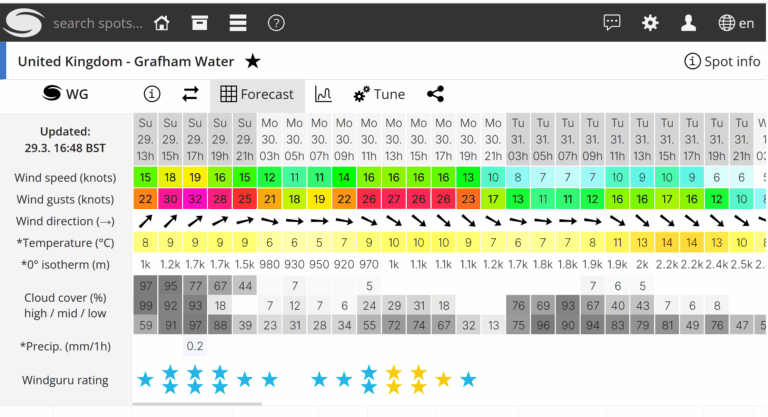
You need to know what the forecast is and select the appropriate equipment for what is expected. We discussed forecasting here.
Forecasts can be wrong. If you turn up and find that conditions are not what you expected, try to understand what might have happened and adjust accordingly. For example, if I had used the forecast opposite but found that at 10:00 the wind was stronger and more Northerly than forecast, I would conclude that the weather had moved a bit faster than the models had predicted and assume the stronger, more Northerly wind was already locked in.
In some cases, local geography will create thermal winds which defy forecasts. Notably, this happens in hot countries in summer, where as the land warms, strong on-shore winds blow up later in the day.
It also occurs in mountainous regions, such as the Northern part of Lake Garda.
These localised wind patterns fall a bit outside of gusts and squalls in that they are predictable if you have the knowledge. If you are going to go out in a new place, it is well worth researching any local wind patterns like this. Research on-line or better still ask a local. The main thing is not to get caught out and find that the wind is far stronger than you had planned for, because managing a gust for the whole session is not much fun.
What causes gusts
The wind will not be constant in any session you have. The average wind you experience will be accompanied by short drops (lulls) and increases (gusts). The degree of variability you experience will be influenced by many things, but as a general rule:
- You will get cleaner, more constant wind where the wind has fewer obstructions to pass.
- You will get cleaner, more constant wind where the wind is travelling primarily over water. Wind passing over land is subject to more temperature changes increasing turbulance.
Therefore, a sideshore or onshore wind on the sea will generally be cleaner and more consistent than the wind on an inland lake.
Looking into gusts in a bit more detail, they are caused by:
- Thermal Effects. Land heating unevenly during the day creates localised areas of rising air with acceleration of the wind.
- Cloud activity. Clouds can pull air upwards, creating stronger bursts of surface wind.
- Terrain. Cliffs, buildings, trees, headlands and hills compress and redirect airflow, resulting in pockets of turbulence.
- Weather systems. A cold or warm front passing through or a pressure system moving can create accelerated airflow.
Spotting a Gust
To spot a gust coming, you need to be looking ahead. Constantly scan the water 50 to 100 metres ahead of you. Looking where you are going rather than staring at the board is a fundamental principle of balance in any case.
Look out for signs of a gust:
- Darker patches of water caused by more ripples.
- More densely packed ripples moving fast.
- White water caused by small breaking waves and foam blown off the top of waves.
- Boats heeling over.
- Windsurfers leaning back more and accelerating sharply.
- Other wingers reacting by accelerating or sheeting out.


Managing the Gust
Spotting a gust coming is the most critical factor in managing it, as it gives you time to prepare and react.
In most cases:
- Keep relaxed with knees slightly bent.
- Unhook the harness if you are using one.
- Keep your weight slightly heelside (assuming you are riding heels to wind).
- As the gust hits you, lean more to heelside, balancing against the power in the wing. Sheet out slightly if necessary, to maintain a comfortable angle of heel.
- If the gust is really strong, feather the wing. I.e. present a more horizontal wing profile, flat and across the wind.
- Put some pressure into the toes and bear away slightly if necessary to benefit from the reduction in apparent wind as you go onto a run.
Top Tip: Sheet out before the gust pulls you off balance. If you get pulled into a position where you are bending forwards from the waist with your bottom sticking out it is hard to recover. You are also in danger of the taco fall, so it might be wise to bail out.
There is a slightly more advanced technique once you are very comfortable heading upwind:
- Keep the wing sheeted in. You can keep the harness hooked in if you use one.
- Carve the board close to the wind so you are on a close-hauled course.
- Sail as close to the wind as you can manage to keep on foil. This method relies on being close to head to wind to reduce the power in the wing.
- Be ready to bear away as the gust dies down back towards a reach.
Spotting a squall
You want to avoid being caught out in a squall. A very large and prolonged increase in wind strength is not fun to wing in and can be dangerous. Being on land when a squall hits is by far the best strategy.
When squalls are more likely.
You should know when squalls are more likely to occur. If you know the conditions that increase the risk, then you can keep a closer eye on the approaching weather.
Squalls are most likely when the weather is unstable.
- Pressure dropping rapidly allowing more fronts to pass through.
- Cold fronts associated with rain showers and bursts of heavy rain.
- Thunderstorms and hail will often be accompanied by violent winds. If hail appears, you’re dealing with a severe convective system and should head for shore immediately.
The warning signs.
Keep your eye on the weather upwind and try to spot signs of trouble.
- Dark low cloud banks. A bank of cloud that appears darker than the surrounding sky, especially if it appears lower and more textured.
- A vertical grey “curtain” of rain falling. In particular, if this is in contrast to the surrounding sky.
- A Shelf Cloud that looks like a bulging lip of darker cloud with textured moving cloud beneath.
- Thunder, even if distant.
- Visible lightning.
- Sudden temperature drop accompanied by a shift in wind direction and/or strength.
- Hail. Hail is usually accompanied by a sharp wind increase.
- Large areas of much darker water with white caps and foam.


The table below gives a summary of what to do if you see these signs. This assumes you can ride on foil confidently in a variety of conditions. Beginners need to be more cautious than indicated.
| Sign | Action | Severity |
|---|---|---|
| Dark low cloud banks. | This is a warning sign. Stay alert and watch out for other signs. No need to go ashore immediately but if you are a long way out get closer to shore. | |
| A visible curtain of falling rain. | If conditions make squalls likely you should consider coming ashore. There is a risk of a squall around the rain, but if that doesn't materialise there is a risk of the wind dying after the rain. | |
| A shelf cloud. | This is a classic squall warning sign. Head for shore. | |
| Thunder. | If the thunder is distant and there are no other warning signs then you can stay out. Consider coming closer to shore if you are far away. | |
| Lightning. | If the Lightning is visible assume it is headed your way. Go ashore immediately. | |
| Sudden temperature drop. | A cold front moving through accompanied by any of the other signs is a red flag. Head ashore immediately. | |
| Hail. | If it starts hailing you probably already missed other warning signs. Head to shore immediately. | |
| Large area of much darker water with whitecaps. | The squall is almost on you. Get to shore immediately by the shortest route. |
Dealing with a Squall
The best way to deal with a squall is to spot it and get to shore before it hits you.
If you do get hit by one, then your aim is to get back to shore as quickly as you can safely manage. That means foiling back at a speed that you can control:
- Head directly to shore; do not worry about your launch point. You can get back to your launch point once the wind falls back to normal.
- Don’t panic, keep knees softly bent and control the foil height.
- Keep speed at a comfortable foiling speed, sheeting out and feathering the wing. Use brief tugs with the back hand to generate short bursts of power.
- If the wind direction is appropriate to the primary goal of getting to shore, bear away to reduce apparent wind.
- If the wind becomes too overpowering to ride safely on foil, try getting in on your knees. Kneel on the board, keeping your bottom low. Hold the wing up but keep a low profile to the wind to reduce the power. Keep speed just below foiling speed, you do not want to try to control the foil in a kneeling position.
- If you are in enclosed water and there is no danger from boat traffic, it may be safer to ride the squall out in the water. Float in the water with one arm holding the board down upwind of you. Hold the wing by the leading edge handle downwind of you, keeping it close to the surface of the water.
- When you get back to shore, be cautious about exiting in very strong wind. Carrying the board and foil out of the water in these conditions can be tricky and the danger of injuring yourself or damaging the gear is greater. If there is little or no shore break, it can be safer to wait it out in the water at a depth you can stand securely without the foil grounding.
Real Life Lessons
Getting caught in a squall is never enjoyable, but I don’t want to put you off. I’ve been caught out a few times without any serious consequences.
Here are a couple of incidents that taught me some valuable lessons.
43 Knots!
Early spring. Cold. Grey sky. Wind on the club dashboard at 25–33 knots. The one other winger at the lake sensibly waited to see how I got on before heading out.
I rigged my smallest wing (4 m). Overpowered, but manageable. I’d already decided to stay close to shore and work on gybes, using a buoy about 350 m offshore as my turning point.
About 15 minutes in, as I headed out toward the buoy, I felt the wind building. A quick look upwind showed darker water and heavy whitecaps racing toward me. I gybed immediately, switched feet — I’m more confident heelside — and aimed for a point downwind of my launch. Bearing away reduced the apparent wind, and feathering the wing with almost no backhand pressure kept things just about under control.
Halfway back, a huge gust hit. The wing generated so much lift it literally pulled me into the air, causing me to crash.
I flipped the wing upright, checked no leashes were tangled, then climbed back on the board. Riding on my knees with the wing low to the water gave me just enough control to ride in at just close to foiling speed. As I didn’t want to try controlling the foil kneeling, I moved slightly further forward and by carefully moderating power, I kept it down.
Once I reached standing depth, I planned to wait it out in the water — carrying the wing and board ashore in that wind would have been asking for trouble. The other winger waded out and offered to take my wing so I could focus on the board. A small act of kindness, but one I was genuinely grateful for.
Later, the club weather station confirmed the peak gust: 43 knots.
Lessons Learned
- Cloudy skies hide warning signs. When everything is already grey, darker patches and rain bands are harder to spot.
- Water state is your early alarm. Had I paid closer attention upwind, I wouldn’t have been heading out as the squall arrived.
- There’s a limit to depowering. Feathering only works up to a point — beyond that, the wing will lift you off the board.
- Kneeling works. Riding on your knees with the wing low is a viable technique in extreme wind. It’s slower than foiling but easier, less risky and more controlled.
- Help each other. If you see someone coming in during a squall and you’re already ashore, go and help them. An extra pair of hands makes a huge difference.
Hail from clear skies
Early summer, late afternoon. The sky over the lake looked mostly clear, with heavier cloud sitting to the north and the faintest rumbles of distant thunder. The club dashboard showed 12–18 knots, noticeably more than forecast, which was probably why just one other winger was out.
I rigged my mid‑size 5.5 m wing. Underpowered in the lulls, but the gusts were frequent enough to stay on foil. I headed further out, where the SW wind is usually stronger and cleaner.
About 30 minutes in, the first warning arrived: a sudden drop in air temperature. Almost immediately, the wind ramped up. Looking upwind, I saw what appeared to be a wall of heavy rain driving across the lake. I was already heading for shore, so I unhooked from my harness to give myself more freedom to feather the wing. As the wind built further, the “rain” revealed itself as hail.
I could just about manage the power by bearing away from my usual return line, foiling back to the east end of the club a few hundred metres from my launch point. I stayed in chest‑deep water, holding the board and wing, sheltering under the canopy to avoid being pelted.
The moment the hail stopped, the wind eased almost instantly — classic convective behaviour. By then the coxswain had closed the lake as he had recorded a 40 knot gust. I therefore had a walk of shame back to the western car park. The other winger told me he’d been watching for me and was ready to alert the coxswain if I didn’t reappear.
- Thunder indicates unstable weather. Even distant thunder is a warning that the wind could change quickly.
A sudden temperature drop is a hard warning. Convective cells often announce themselves with an abrupt cooling as the downdraft reaches the surface. If the air feels noticeably colder within seconds, assume the wind will increase sharply.
“Rain” that looks too dense probably isn’t rain. Hail often presents as a grey, opaque curtain with a harder edge than rainfall. Hail falling on water creates more of a splash.
Unhook the harness ahead of the wind increase. Being able to feather the wing and adjust your angle of attack without harness load gives you more control when the wind jumps suddenly.
Your return line may not be the safest. In a squall, the safest course is the one that reduces power, even if it means landing away from your launch point. Prioritise control over convenience.
Look out for each other. Awareness of others safety is valuable. Look out for others as you would hope they will for you.
Meteorology: Why Hail Brings Strong Squalls
Hail is a signature of powerful convective storms. Even when the sky looks mostly clear, isolated convective cells can build vertically, producing strong updrafts that carry raindrops high enough to freeze into hail. These cells can sit behind ridgelines or distant cloud banks, hidden until their outflow reaches you.
The temperature drop, the squall's first tell is the outflow boundary. This is the cold downdraft spreading out at the surface. This outflow boundary behaves like a miniature cold front: the air suddenly feels colder, the wind jumps, and the gusts become more erratic.
Gusts come from the downdraft hitting the surface. When the downdraft reaches the lake, it spreads horizontally, accelerating the wind. This is why there is a rapid increase in wind strength as the hail arrives.
The conditions that create hail are associated with the convective process that create thunderstorms, but the systems can move apart. Thunder is a warning sign not a guaranteed symptom.
Other Sources – Useful videos
There are really not that many videos that cover this topic. This short one is good at showing you what to look out for in terms of an approaching gust. Bear in mind that this has been shot from a moored boat that is head to wind. When winging, you will be looking for gusts more at an angle over your shoulder.
If you come across a better video or have a story of your own to share, please leave a comment below.
If you found this article helpful and would like to buy me a coffee, then thanks!
Let’s get out on the water, learn to love the gusts and dodge the squalls. Let’s Go-Wingfoil.