
Introduction
So you have your beginner gear and you are ready to Go-Wingfoil. Understanding the ideal conditions and location will help you get the most enjoyment out of your early sessions and to start your journey learning our sport safely. In this article we will look at what to look for in a location, what weather conditions are best and how to forecast what the weather is going to be.
In a nutshell (tl;dr)
You must have:
- A location with a safe entry and exit when carrying the board and wing. No jagged slippery rocks to fall on no heavy breaking waves.
- Relatively flat calm water. In your early sessions balancing on the board is hard enough without waves complicating matters.
- A safe exit downwind of your launch point. All beginner wingfoilers end up down wind of launch in their early sessions.
- Cross-shore wind. On shore wind is too hard for early sessions and off-shore wind is dangerous for beginners, do not go out in off-shore wind at this stage.
- A location with no strong currents to contend with.
You should have:
- Enough wind. 12 to 25 knots, less than that is frustrating more than that is a challenge for a beginner.
- Clean wind that is not too gusty. Gusts that double wind strength are a challange so if it shows 15 knots with 30 knot gusts you should probably sit it out and watch the experts.
- Other wingers around. There is a safety element to this in terms of looking out for each other, but also you will benefit hugely from chatting to other people who will be only too happy to share tips.
- Space to set up your gear and blow up the wing.
It is nice to have:
- Safety cover in case things go wrong.
- Changing and shower facilities.
- Cafe for refreshment after a tiring day on the water.
- A primary location that is not too far from home. Time on the water is key, and having somewhere convenient to get to will mean more sessions.
To obtain this you should:
- Scout possible locations and understand how they measure up in different wind directions.
- Get familiar with wind forecasting apps. Windguru is my personal favourite.
- Have options that allow you to go out in all wind directions. I.e. an off-shore wind at your main location is cross or cross-on at your backup location.
As you gain experience you will learn which elements you can compromise on. Try not to wait for the perfect day the only way to learn is by being on the water.
How to enter the water safely with a Wingfoil
Entering the water as a beginner carrying your board with sharp foils kept well clear of your inflatable wing is challenging enough without adding additional hazards. You want a location where you can safely walk out into the water carrying the board under one arm with foil towards the wind (a board with a handle helps) and holding the wing in the other hand flagged out using the leading edge handle . As a beginner avoid:
- A location with heavy wave action on the shore. “Shore dump” can knock you over and bring the foil in contact with you or the wing.
- A location with slippery or very uneven rocks that may cause you to stumble or slip.
- A location with sharp hazards (such as Oyster shells) that are surfaced in the time window you will be going out or coming back.

The exit is the reverse of entry. Jump off the board in water deep enough to accomodate the foil mast. Get yourself downwind of the board, get the wing downwind of you and under control and turn the board so the foil faces into the wind. Wade out and carry your equipment back to a point where it is safe to put things down without damaging anything.
You want flat water to start with – here’s why
Once you are a competent foiler, waves can add a lot of fun. As a beginner, though they are a complication that you can do without and you want a spot that has relatively flat water. There are several reasons for this:
- When you are starting out kneeling on the board and retrieving the wing is challenging enough without adding the extra complication of waves tilting the board under you.
- Once you are on your feet and taxiing it is again easier without waves trying to tip the board under you.
- Getting the board to take off speed is more complicated in waves as running the board into the wave will slow it down.
- Once you are up on foil waves can accelerate the foil in an unpredictable way making first flights more difficult.
All in all flat water will make those first sessions easier and more productive. Look for inland water, a river or estuary or a bay that provides some shelter and offers a flatter section of water. If you live near the sea then understanding how the tides and different wind conditions effect the sea state will help you spot the days when there is less wave action to contend with.
Why you need a safe landing downwind
Beginner wingfoilers will all end up downwind of where they launch. This is because:
- You spend more time on your knees getting started and have more falls so have more times that you need to get started. During this process you inevitably lose some ground down wind.
- Whilst taxiing it is harder to make ground upwind than when you are consistently on foil. So making up lost ground is hard.
- You want to bear away (there’s a refresher on points of sailing here) in order to take off. So when chasing your first flights you have to be prepared to lose some ground to get the speed you need to fly. Being to focussed on getting back to a spot on shore can actually be a barrier.
Rather than worrying too much about the downwind drift embrace it as part of the process. Every wingfoiler has been through this and endured “the walk of shame” as they carry their gear back to where they started. You are learning something new, accept this is part of the process and think of it as “the stride of pride” instead.
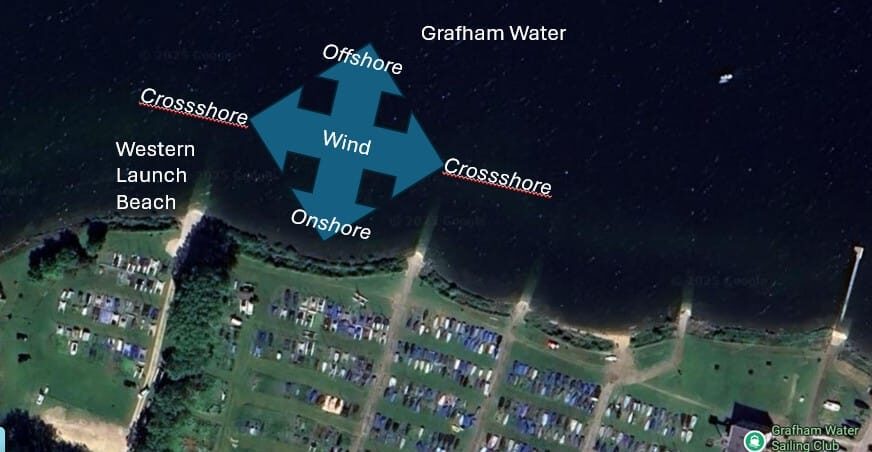
The diagram below illustrates how my home spot Grafham Water provides a relatively wide safe landing area in a westerly wind if you launch from the west end of the club.

Why you need avoid current
In case it is not obvious you need to be wary of going out anywhere that has a current. A current that flows off-shore is obviously potentially hazardous. But any current that moves you away from your launch and landing site is an added complication. Generally currents will be created by tides, so are associated with coastal spots. Be aware that a spot that may be fine to wing at around high-tide might become dangerous mid-drop. For this reason when scouting locations ask locals that you see winging about when you can go out.
Putting it all together – scouting locations
The single best way to identify a good location near to you is seeing that other Wingfoilers are there. Talk to them and ask questions:
- Is this spot cross-shore in the prevailing winds for the region – generally SW in the UK.
- In cross-shore breeze how easy is the exit downwind of the launch spot.
- How flat is the water and are there any times it becomes wavy (e.g. low tide versus high tide).
- Is there any shore dump to contend with (e.g. at high tide)
- Are there ever currents to worry about.
- Are there any dead patches with wind-shadow to consider.
- Do you need to worry about water depth as the tide goes out (e.g. can you end up with a long walk in at low tide).
- Is it easy to park and rig your gear.
How to forecast wind conditions
Once you know where you will go out you need to look ahead and see which days look like they will offer the best conditions. The general weather forecast for your area is useful (The Met Office in the UK), but there are specialist Wind forecast apps that I personally use and think are better.- WindGuru provides forecasts for spots globally. I find it to be generally very reliable. The forecast for 10 days out is always subject to change but generally it will be right for the next day or two.
- WindFinder is another site that many of my friends at the lake use.
- XCWeather is a useful addition in the UK as it has a live weather map that shows wind strength across the country. This can help you predict what conditions are going to be like in the next few hours.
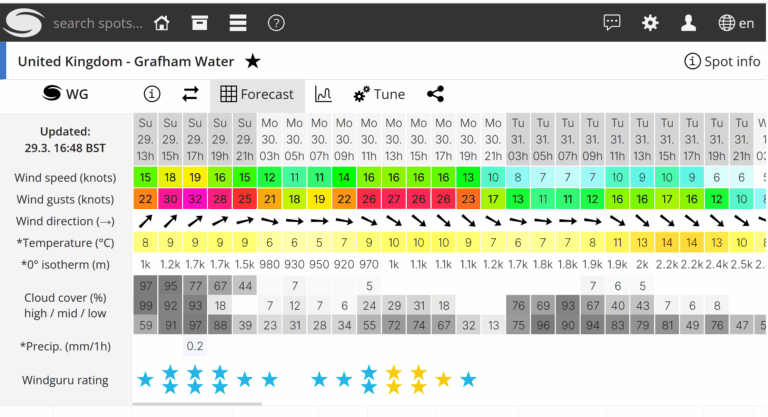
If you plan on winging on the coast or a tidal estuary then you will also need to know about tides. Windguru also shows tide times and the range of the tides (it’s not a big factor at Grafham Water!). Alternatively, look for tide tables for a local harbour.
Whilst the forecasting apps are quite good the weather is not 100% predictable. If you can get a live update from a weather station near your spot that will be very useful. In particular if you live nearby you might find that the wind picks up at some point in the day and you can grab a quick bonus session.
Note that in some locations there are specific thermal winds that are caused by the terrain. Here the forecasts are much less reliable (or totally useless). Lake Garda for instance has winds driven by airflow into and out of the surrounding mountains. If you live somewhere like that then hopefully you already understand these patterns, if not chat to fellow enthusiasts.
Once you have a couple of spots identified you can look at the forecast and cross your fingers for 12 to 25 knots in a direction that is cross-shore at one of them.
Should you join a club?
Joining a sailing club obviously increases the expense but I would suggest giving it consideration.
A club has a number of benefits:
- Other wingers to talk with, observe and get ideas from.
- Changing facilities for winter.
- Increased security for your gear and parked car.
- Safety cover (probably).