
Most beginner Wing Foilers will have some experience of other wind sports such as Wind Surfing. Intuitively they will understand how the wing interacts with the wind as the principles are the same as a conventional sail. If you don’t have that experience then I would suggest that a few lessons to get you started would be a very wise investment, if nothing else for safety reasons.
This article is for those that like to understand not just what to do, but why. It is also a recap to ensure that the other articles in the Classroom section can be understood in a consistent way.
Understanding the Engine: How Your Wing Interacts with the wind
How Bernoulli’s Principle lets you go upwind
The ability to go upwind (i.e to make ground towards where the wind is coming from) relies on the design of your wing. The leading edge and strut of an inflated wing creates a curve similar to an aeroplane wing. As the wind flows over the curved surface of the front of the wing it has further travel than air passing on the inside (the handle side). Therefore the air travelling around the front of the wing is travelling faster.
- Faster air = Lower Pressure (Bernoulli’s Principle)

The difference in pressure between the high-pressure side (inside the wing) and the low-pressure side (the front of the wing) creates lift, or in our case, drive allowing you to travel towards where the wind is coming from. A general rule of thumb is that you start to lose drive (power) from the wing at around ~45 degrees towards the direction of the true wind and you lose all drive around ~ 30 degrees. There are two reasons for this:
- The wind pushing on the outside/front of the wing starts to deform the canopy so that you lose the curve. The canopy will start to flap and the Bernoulli effect is diminished.
- The relatively large leading edge of the wing (compared to a windsurfer mast for example) causes turbulence on the inside edge of the wing which further disrupts the power of the wing. This effect is being addressed by some manufacturers of race wings by introducing a dual skin with an inner canopy to reduce turbulence.
Understanding points of sailing
As discussed you cannot sail directly towards the wind. The main directions you can sail are:
- Close hauled/Close reach. By sheeting in the wing hard (i.e. pulling your back hand in close to you) you can travel upwind. Off foil taxiing you will struggle to get closer than around 45 degrees to where the wind is coming from. Once you are up on foil however the lack of drag allows you keep going with less drive from the wing and to point much closer to the wind ~30 degrees. Once you master that, the “walk of shame” becomes a thing of the past.
- Beam Reach/Broad Reach. This is the most powerful angle for your wing. The wind blowing into the back of the wing and the air flowing round the front combine to maximise the power you are getting. This is the key to getting up and foiling. When you are trying to get on foil concentrate on sailing at 90 degrees or slightly more off the wind, it really is the only way you are going to take off.


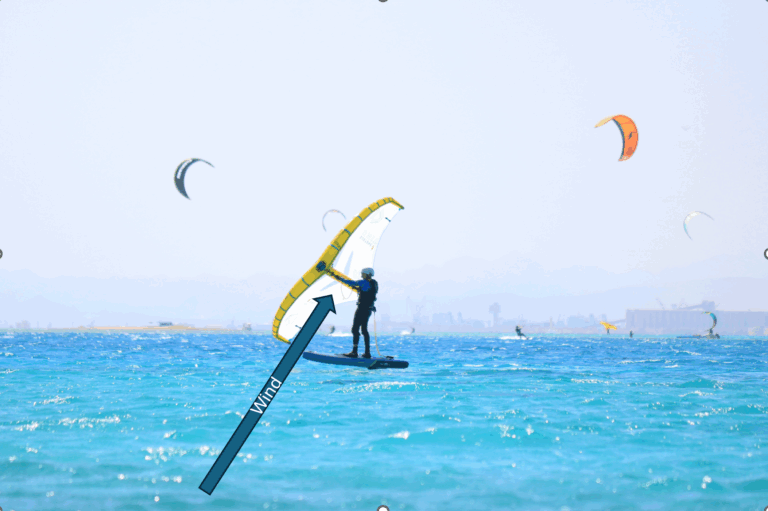
- Sailing Straight Downwind (Running): Somewhat counterintuitively this is the least powerful direction. The wing is being pushed from behind by the wind and there is little or no Bernoulli to help. In addition as you are moving away from the wind pushing you, your speed through the water reduces the apparent wind (the wind you feel based on the true wind combined with the wind created by your motion) and therefore the drive. You will want to avoid this course in your early sessions and save the frustrating loss of power for when you start learning to gybe.
Other Key Terminology
The illustration below illustrates two key terms to understand:
- Head Up: Means to turn the board up into the direction the wind is coming from. You will need to pull the wing in tighter (sheet in) when you do this.
- Bear Away: Means turning the board away from the direction the wind is coming from. You will let the back hand on the wing out more (ease or sheet out) when you do this.

Of course in reality wind does not neatly follow the diagram and blow from one direction.
- A header is when the wind shifts in such away as it is coming more from in front of you. If you were sailing close hauled or on a close reach you will now need to bear away to stop the wing flapping.
- A lift is when the wind shifts the other way to come more from behind you. If you are trying to make your way upwind this is an opportunity to head up, sheet in and point closer to your desired direction.
- The board in the illustration is on a port tack because the wind is coming over the port (left side) of the board and the wing is on the starboard side.
- Were the winger to turn around and come back into the diagram in the opposite direction with the wing on the port side, they would be on Starboard Tack (wind coming over the Starboard side of the board).
This is an important concept as when two sailing vessels are approaching each other the Starboard Tack craft has priority and the Port Tack craft needs to take action to avoid collision. Knowing the rules on avoiding collision are important, if you are not familiar with them then this video is a good place to start.
Finally the way you turn the board around from one tack to the other is determined by relative movement to the wind.
- Gybing is the action of bearing away from the wind until you are running straight downwind then turning further whilst switching the wing to the other side at which point you are broad reaching on the new tack.
- Tacking is the action of heading up into the wind so that the nose of the board passes through the head to wind direction and shifting the wing to the opposite side of the board. At that point you are sailing close hauled on the opposite tack.
I hope that this recap on terminology has been useful, and that it will allow you to interpret the other classroom lessons with confidence. If you have questions then please leave a comment and I will try to answer it or update the article.