

Considering Wing Foiling – The Top Ten Questions
In a previous post I provided an overview of the benefits of Wing Foiling. In this post I will look at what the top ten questions people that are considering taking it up ask (according to Gemini AI, based on Google search). I’ll give you my honest perspective as someone who took it up in their early sixties. There are some specific considerations for “Foilers over Fifty”, but most of the points hold true for everyone.
To avoid writing war and peace in one post I have split the post in two parts. Part one answers questions 1 to 5. This post answers questions 6 to 10.
In a nutshell (tldr)
No time for long form answers? the following is the summary but it misses lot’s of nuance that follows.
- Is Wing Foiling Difficult for someone over 50?
- Do I need prior watersports experience?
- What is the best beginner gear?
- How much does it cost to get into Wingfoiling?
- How long does it take to learn Wing foiling?
- What are the biggest safety risks and how to avoid injury ? The main risk of injury comes from falling onto the board or foil. Wear a wetsuit, impact vest and helmet. The other risk is being unable to get back to shore. Avoid off-shore winds at the beginning, look for a location that provides safety cover, and consider taking a mobile phone in a waterproof pouch for emergencies.
- What are the physical benefits of wing foiling in particular for an older person? Wing Foiling provides a good workout in the fresh air. Balancing on the board/foil develops core strength and pumping the wing to get onto foil gives bursts of aerobic effort. For the older winger the needs of the sport will give you added incentive to work on fitness and flexibility. Finally there is the mental health benefit, foiling never fails to lift my mood.
- What kind of water and wind conditions are ideal for beginners? Flat water helps a lot when learning as it makes balancing on the board easier. Steady winds of 12 to 25 knots cross shore is an ideal wind. A key consideration for beginners is where you can land downwind, you will struggle to stay upwind in your early sessions so you want a location where you are able to land safely and walk back.
- Where can I take lessons and are they necessary? Whether you really need lessons will depend on previous experience. If you have extensive Windsurfing experience, you can certainly get started by yourself, there are numerous resources on YouTube. If you do have lessons I would look for radio headphone communication and boat support. Use Google search to find the nearest lessons, approach your local sailing club or consider taking a holiday somewhere warm.
- How does wing foiling compare to other sports like windsurfing or kiting? Riding on foil is a very different feel to blasting on a windsurfer. It feels a bit more like surfing and lends itself to carving the board through turns and catching small waves rather than straight line speed. The wind range you can enjoy is also greater, I can have great sessions in anything over 10 knots. Compared to kiting the big difference is accessibility, with no kite to launch there are many more locations where you can go.
If the summary answer above isn’t enough you can find more detail below. If having read this and part one , you have a different question then feel free to leave a comment and I will do my best to answer.
But finally consider the couple in the image at the top. I often see people on the shore watching me and my winging buddies out on the lake, sometimes they will take pictures. Life is not a spectator sport, be the person in the picture not the observer on the bank. Let’s Go-Wingfoil.
What are the biggest safety risks and how can I avoid them?
Nobody wants to get injured of course but for us foilers over fifty who heal more slowly, this is even more important.
The most obvious safety risk of course is falling onto the board or foil and damaging yourself that way. For this reason you will want to wear:
- A full wetsuit to protect your knees from wear and tear kneeling on the board and your lower legs from accidental contact with the sharp edges of the foil.
- A helmet, I have had my foil come down on my head in a bad crash and I hate to think what would have happened without a helmet.
- An impact vest which protects the torso and provides flotation.


Aside from protective gear:
- A beginner foil with rounded tips is less of a hazard.
- Learn to fall safely, try to get downwind of the board with the wing away from the foil. My worst falls having been from trying to fight an inevitable fall rather than bailing out and putting space between me and the sharp bits.
The other obvious danger is getting stuck out on the water unable to get back to shore: There are a number of safety considerations here:
- Avoid going out in offshore wind during the beginner stage.
- Look for a location with safe exit downwind of your launch point. You will almost certainly lose ground downwind in the early days and you need to know you can safely come ashore and walk back.
- Learn to self rescue by paddling the board and dragging the wing with your feet.
- Consider joining a club that provides safety cover for additional peace of mind.
- Consider taking a mobile phone in a waterproof case so that you can summon help if needed.
- Go out with other wingers (and windsurfers) and keep an eye out for each other.
- Generally a good level of fitness will help you to learn and to avoid injury whilst learning. So a good varied exercise regime will help you.
- Flexibility and stretching will help with aches and pains after a wing foiling session. I have found Pilates routines (especially the Pigeon Pose) help me, and after long sessions I now do a stretch down, which has reduced stiffness in my quads and lower back.
What are the physical benefits of wing foiling especially for an older person
According to my tracking app Hoolan an hour long session of wing foiling burns over 500 kilocalories, and my maximum heart rate is often over 150 bpm. So there is undoubtedly a strong element of aerobic exercise. Aside from that the constant small adjustments that it takes to ride the foil will give your core muscles a good work out. Pumping the wing to get onto foil works arm muscles and the effort to stand from kneeling works the major leg muscles. So there are certainly physical benefits.
Importantly, as someone who goes wing foiling whenever there is enough wind, I can attest to the fact that this is not exercise I need to force myself to take. Whereas I might need to talk myself into doing a HIIT session or going to the gym, if the winds up I want to be out on the water. The secondary effect of this is that when the wind is down for a few days I have extra motivation to exercise so that I stay in shape for my next session.
If you have the right equipment and are prepared to put up with a bit of cold then you can also wing foil all year round. When the weather is cold and miserable I can easily persuade myself to go out for an hour knowing I will have fun and thoroughly enjoy the hot shower after.
Finally there are undoubtedly mental health benefits to doing a thrilling and absorbing activity in the fresh air. A wing foiling session never fails to lift my mood.
Are Wing Foiling Lessons Necessary and Where Can I Take Them?
My own experience with lessons is mixed as I will explain. So when it comes to whether lessons are a necessity the answer is no. The extent on your existing watersports experience is important. If you have zero experience of wind sports, then I think a series of lessons to start you off would almost be a prerequisite. If you are an experienced sailor with windsurfing or kitesurfing experience I think you can certainly take the first steps without lessons.
For the experienced windsurfer the initial steps of riding the board, getting to your feet and handling the wing will feel different but not totally alien. It is entirely possible in my view for someone in this position to skip lessons on “Wing Surfing” and teach themselves the basics with few downsides.

My own starter lessons were a waste of money, we walked through wing handling on the beach, the instructor repeated a number of things I already knew from YouTube, then out on the water, he shouted vague instructions from a distance that I couldn’t hear.
If you do decide to “do it yourself”:
- Watch a selection of the many excellent YouTube videos on getting started.
- Talk to experienced wing foilers at your local spot and ask questions.
- Practice wing handling on the beach including how to flip the wing, lift the wing while kneeling on the board, use the power in the wing to help you stand and then trimming the wing sheeting in and out. The investment of time on this will more than pay back.
- Expect to end up coming ashore downwind and walking back, embrace that as a rite of passage.
- Go for it, time on the water is the only way to master it so enjoy the process, celebrate each victory (longest taxi, least time on knees, shortest walk back to date).
For the next step of mastering flight I think the right lessons will be more of a benefit. It is still possible to self teach but I think that an experienced teacher can really help. I had some very good lessons in Dakhla as someone that was in the early stages of mastering flight. My instructor’s English wasn’t great but he was clearly thinking hard about what to tell me and the little diagrams he sketched and my workable French meant I really improved my control over both the height and direction I was riding. If you go for lessons I would look for:
- Radio communications through a headset. That way the instructor can provide real time feedback as you try and master first flights. This immediate real time feedback is way more effective than after the fact discussion on shore.
- Boat support. If they use a boat to start you upwind and support you on the water then you are free to concentrate on getting enough speed to get the foil to lift (which you have to bear away to do) and not worry about getting back to a distant figure on the beach.
- See if you can observe the lessons first. Is the instructor doing more than parroting things you already heard on YouTube.
What kind of Wind and Water conditions are best for beginners?
Let’s start with the most basic consideration. Is it easy to get into and out of the water carrying your board and wing, whilst keeping the inflatable wing and sharp foil separate. Trying to get in and out in even moderate waves can make life quite hard for a beginner. Therefore inland water or a sheltered sea access with minimal “shore dump” will help. If you are going to go out in the sea then you will need to understand how wind direction and tide times impact the amount of swell hitting the beach.
Once on the water a beginner will benefit from flatter water with less wave action. Riding the board and getting to your feet are hard enough without introducing extra complications with waves.
In terms of wind strength you would ideally have steady 15 to 20 knot winds. Less than 12 knots is a real struggle for a beginner, you can still have fun in a bit less, however below 10 knots becomes frustrating as there is less power in the wing to help you stand and you will not have the technique to pump up onto foil. The upper wind range will depend to a degree to the wings you have and how experienced/brave you are. Once winds get above 25 knots a beginner should probably be thinking of watching the experts to pick up tips.
Aside from wind strength one of the other variables you will need to understand is wind direction and how this interacts with your chosen location. In case you are unfamiliar the illustration below explains the key terminology of:
- Onshore
- Offshore
- Crossshore
- Upwind
- Downwind
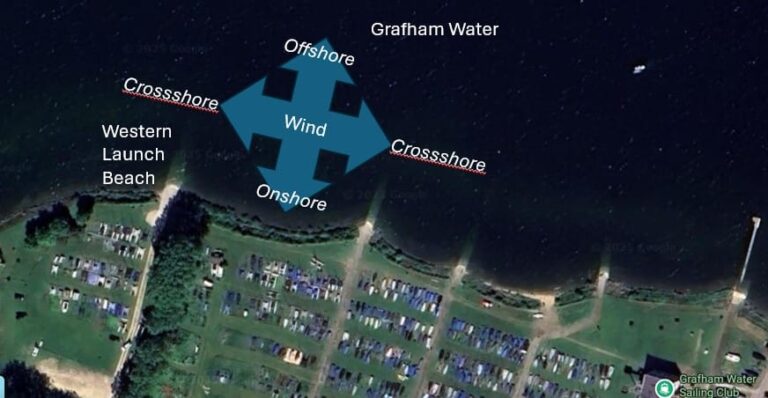


As a beginner you will want to avoid offshore winds that could make it difficult to return to shore. Directly onshore wind can be hard to get out against so cross shore winds that blow to a significant degree along the shoreline are ideal. Even in cross shore winds you will want to go out somewhere that allows you to safely come ashore downwind of where you started. Beginners will inevitably lose ground downwind and every wing foiler out on the water has experienced “the walk of shame” (carrying your equipment back to your start point from downwind).
Given variability of weather it is worth trying to find a few different locations so that you always have a spot that you can go regardless of wind direction.
If you are incredibly lucky there will be a flat water coastal spot nearby (perhaps a bay or estuary) where you will get the cleanest winds and flat water and multiple launch points to suit all wind directions. If you find that leave a comment, I want to ride there!
How does Wing Foiling compare to other wind sports like Windsurfing and Kite Surfing?
At my home spot there is friendly rivalry between the different disciplines. Many people that are now Wing Foiling have come across from one or both of kiting or windsurfing and there are still some that participate in all of them.
I am now 100% loyal to the foil, but I enjoyed windsurfing for many years. My observations on the differences there are based on my experience. I have never kited so my comments there are based more on observation.
Similarities to Windsurfing
- Standing on the board holding the wing is similar to balancing against the sail of a windsurfer.
- The wing behaves similar to a windsurfer rig (with some differences) and using hard handles or a boom you have a very familiar feeling to trimming a sail.

- Foot position to trim front back and side to side are similar.
- Windsurfers will find using a wing harness very easy as a development (not a necessity for beginners)
- Windfoilers will be familiar with the feeling of foiling and should find crossing over fairly easy
Differences to Windsurfing
- Riding a foil is a much lighter, and more maneuverable experience than riding a windsurfer board. The light board, and riding on a foil makes carving into tight turns easy. Wingers tend to turn more and chase little waves or gusts rather than blasting in a straight line.
- A wing is easier to manage in big gusts than a windsurfer rig.
- If you can catch waves and surf on foil you can flag the wing out behind you (with practice) and just forget about the wing. You can’t do that with a windsurfer rig.
- Wing Foiling requires more balanced foot pressure between front and back foot. Muscle memory of windsurfing will tend to make you too back foot heavy at first and will hinder you getting on foil.
- If the wind completely dies a windsurfer is more comfortable to get back to shore, Wing Foiling when the wind has completely died is a miserable experience.
- The behaviour of the wing has some similarities to a kite as both have a large inflated leading edge which has a big impact on how they drive through the wind.
- Kite surfers that learn to ride toe side will be more familiar with the toe side stance a Wing Foiler has post gybe. This is very alien to windsurfers.
- Kite foilers will have a big step up in terms of understanding of riding on foil
- In wing foiling if something goes wrong you can let the wing go. However much safety has improved there are added risks in kiting being attached to your power source.
- There is much less capacity for big jumps and prolonged air time in winging compared to kiting.
- Wing foilers need deeper water (minimum 1.5 m) than kiters who can be happy blasting in shallow lagoons where we would ground the foil.
- Because of the space needed to launch and retrieve a kite safely there are lots of restrictions about where you can do it. This is not the case with wing foiling which has far more locations available.